
showing up
#4

A film I’ve thought about pretty much weekly since I saw it is Kelly Reichardt’s Showing Up, which gives this newsletter its title. I haven’t written about the film apart from mentioning how much I liked it on Twitter a few times but I thought it might be nice to do so here, for the few people who subscribed to this newsletter wanting arts criticism instead of (or perhaps as well as) the sinewy contents of my cracked-open rib cage delivered with an arched eyebrow and a wan smile.
Before I go further: I know a lot of UK folks won’t have seen the film yet (it’s playing the Prince Charles in London in February, and I believe getting a DVD release too). You can’t really ‘spoil’ a Reichardt film, and I’m using a few details as jumping-off points more than ‘reviewing’ the film as I usually would, but I will talk about the ending, so consider this your warning if you’d rather not read anything on it!
Now then.
I’m not as much of a Reichardt devotee as some of my peers, but only because I came to her late. I was in my mid-twenties and felt like a fraud existing in the film space as someone with no formal education in cinema by the time I saw a Reichardt film for the first time.
With Kelly Reichardt, I sort of unconsciously decided her films would be my own little journey. Not something I was writing about, or even really talking about. There are a few reasons for that, I think…I sometimes find it a little difficult to engage with writing on Reichardt (not to say there isn’t some lovely stuff out there) and I \ have a strange relationship with nature in cinema (too much green and too much silence reminds me of the place I always hated growing up). Then, I see shades of myself in her protagonists that I struggle to articulate satisfactorily. But I think it’s nice as a critic to have some filmmakers whom you haven’t “tackled” yet. As someone who puts a lot of herself in her work (it’s okay if you think it’s too much) it’s nice to keep some secrets.
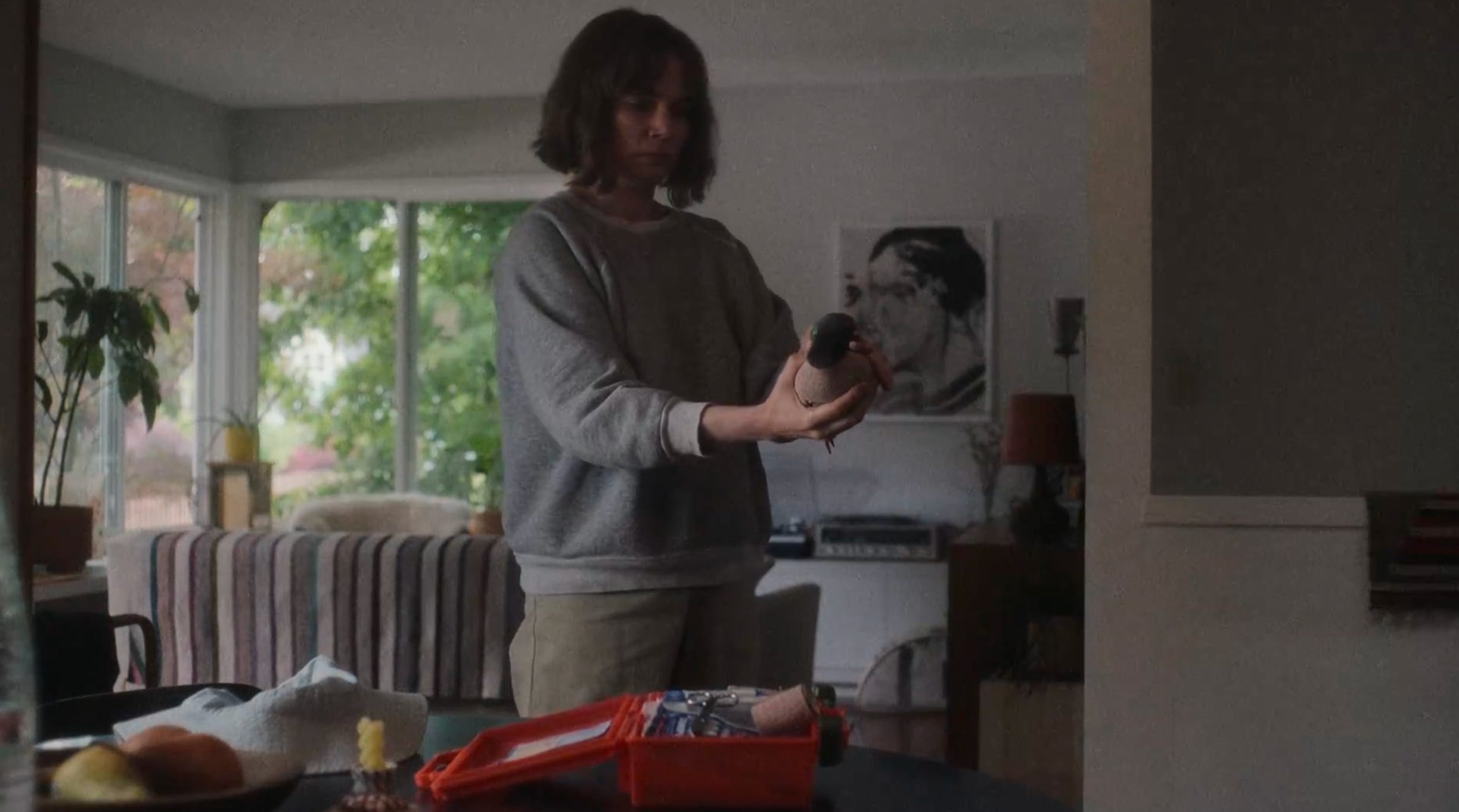
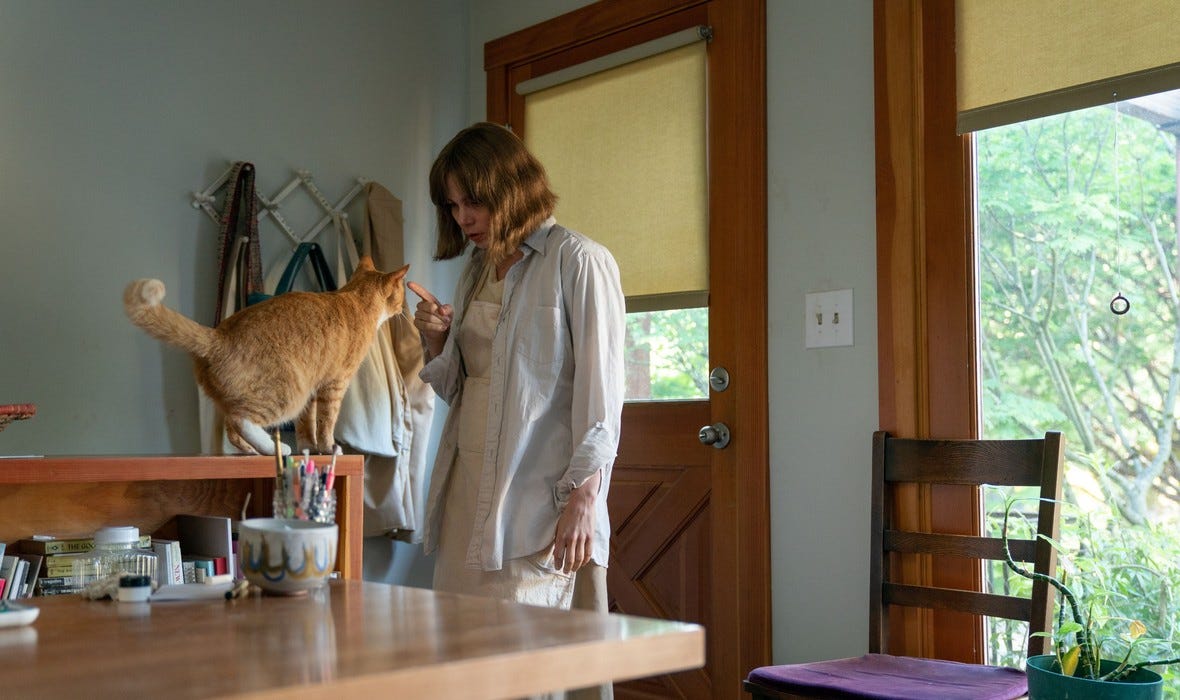
Anyway – the films themselves I adore, particularly the relationships between humans and animals that Reichardt shows. In Showing Up this largely relates to Lizzy’s mischievous ginger tomcat Ricky and the poor pigeon he catches and brings into his exasperated owner’s house. After Lizzy tries to dispose of the not-long-for-this-world bird by putting them back on the street, her well-meaning landlady and neighbour Jo (played by the excellent Hong Chau) scoops the sad pigeon up, and somehow, Lizzy ends up nursing the damn bird back to health. Ricky the cat is largely indifferent, as is a cat’s way.
If I ever met Reichardt I’d probably like to ask her about cats. She’s a dog person, but I think she captures the sort of benevolent menace that a housecat invites. They are so small and soft and helpless, so graceful and clever and funny, but they are also vicious, occasionally poisonous little raptors. My heart is often so full of love for Margot I tear up just thinking about her. I’m tearing up right now because she is asleep next to me as I write this and I look down at her soft fur and small features, listening to the gentle wheeze of her snore, I don’t think I could be any more devoted to another creature if I tried.
Lizzy and Ricky are more like roommates – where one is in charge of paying the bills and the other lays on the couch all day with promises that they’re “good for the cheque”. That’s relatable too. My mum, who has five cats, took in my two university cats when I moved to London (they’re outdoor cats and I didn’t trust them with the roads here). Walter, the silliest, biggest, loudest, more charismatic of the five, constantly sprays everywhere. He’s done this since he was three, and moved from Leeds to Sheffield. He’s now eleven. For eight years my mum has put up with the blasted cat pissing on the walls, on the sofa, on the doors. Sometimes he makes direct eye contact with you while he does it. They took him to the vet years ago out of concern it was a sign of stress or illness, and the vet’s professional diagnosis was “He’s just a dickhead.” I’m sure dogs can be dickheads too, but I can only speak to my experience with cats, who are real masters of the form.
Anyway, I digress – back to Lizzy and Ricky. Lizzy, a ceramicist and administrator at the art college where her parents teach, exists in a seemingly perpetual state of mild stress. I’m not talking Howie Ratner levels of running across New York to avoid getting pistol-whipped – I’m talking about the low-level dread of going without hot water for weeks on end, or of trying to be creative while also living under the constraints of capitalism (I think Reichardt’s films often deal very beautifully and eloquently with this idea, of how we try to make space for beauty and expression in a world increasingly hostile to it).
We only see a few moments in the film between Lizzy and Ricky, mostly her reasoning with him, which is a) very accurate to my experience of owning cats b) a wonderful observation of the innate chaos that welcoming a cat into your house invites. I think there’s a reason so many artists and writers are drawn to cats, besides their obvious cuteness – they cannot be reasoned with. A cat is as a cat desires to be. If a cat is unhappy, you will be the first to know about it. They are the masters of their own fate. I think that freedom of spirit is inspirational and envious and daunting.
But if you earn the trust of a cat – which is earned, not won – any cat owner will tell you they are the loveliest of creatures. I’ve always admired how discerning many cats are (not all – Margot and Walter are pretty friendly to everyone) and I do admire the capricious nature of many of my feline friends. You never know what a cat is thinking. How delightful and mystifying! (I rarely know what other people are thinking either, but that I find less delightful, and probably more mystifying).
This brings me to something I’ve been talking a lot about in therapy – stop booing, you knew I’d be clawing some of my insides out for inspection at some point, this is newsletter number four – the concept of showing up. The title of Reichardt’s film is multifaceted, referring most plainly to the artistic practice of ‘showing’ (which Lizzy is preparing to do with her art in the film), then to the excruciation of being ‘shown up’ by one’s family or friends (or cat) or being ‘shown up’ as in made to feel inferior, intentionally or not. And then, finally, most pertinent in my opinion (and to the therapy chat which I promise I won’t bore on about, it’s just for the context this has been on my mind) the idea of who you ‘show up’ for, and who ‘shows up’ for you.
I’ve been feeling really down for the past few months about the dissolution of some friendships, which is a byproduct of driting into my thirties. Genuinely very upset, to the point I’ve talked it out with multiple friends, as well as at therapy. The realit is, people change, people grow apart. Distance, even when not really geographical, becomes hard to bridge. Sometimes people stop being friends because they never really had anything in common to begin with, or they find people who they just like better. It’s not really personal. However, as a chronic overthinker who takes everything so, so personally, my instant reaction to a friendship changing is to assume I have done something hideous to someone that I don’t know about, and now they hate me and have severed ties with me, leaving me to sit alone, an ignorant fool with no idea how I’ve ended up alone in the first place.
(I recognise this is very self-centred and I am working on that, don’t worry.)
The truth of the matter is that people are busy, life is short, and we only have so much capacity in our lives for others. And there’s so, so many people in the world. Of course, you can’t have all the friends at 31 that you had at 21. 21-year-olds are like the Terminator when it comes to social battery and lack of pressing life commitments. Your thirties, as I understand them so far, are about figuring out who shows up for you, who you show up for, and – most difficult, perhaps – what ‘showing up’ looks like. Is it a text message just to see how they are? A conversation chain consisting entirely of memes? Dinner, drinks, supporting or sharing their work? How do I show up for people I care about, and how would I like people to show up for me? How do you express this in a manner that is not pass-agg? How do you expect people to remember? How do you remain conscious that friendship is a two-way street while also not treating it as a transactional relationship?
That’s a lot of questions – sorry. I’ve had so much time to think this month. I’ve been really, really unhappy, and quite desperately insecure about myself, my friendships, and my work. But the questions have also been on my mind to some extent since I saw the film, which I think is about loneliness and connection with other people as much as it’s about labour and pigeons and art.
Kelly Reichardt ends Showing Up with Lizzy and Jo walking together after Lizzy’s modest exhibition opening, discussing their friend Mike, who’s gone back to painting deserts again instead of trees. The camera stops following them as they walk away, instead slowly moving upwards until they’re two small figures in the distant glow of the sun, and the sound of a pigeon gently cooing replaces their conversation. It’s one of my favourite endings of the past few years, understated and funny and of course, very Reichardt, but I think more than anything, there’s something I find so warm about the moment. Lizzy and Jo have a strained relationship (Jo is Lizzy’s scatterbrained landlady and a more successful artist) but the peace in that final moment speaks to the peace of being with someone who understands you. It might not be perfect – sometimes it’s very much the opposite – but it’s reassuring. I think being seen in that manner is quite rare and beautiful. I suppose that’s what many of us are looking for, deep down.

There’s plenty more I love about Showing Up, but I think I’ll leave it there. Margot has woken up and is headbutting me, and it’s past midnight now anyway. But it’s a really brilliant film, and if you can see it at the cinema, I think the sanctity of the big dark room helps you be as present as possible.